New Zealand to Taiwan
The following is based on the rules and conditions in March/April 2020. To stay up to date on the current rules, see the links at the end.
It has been just over a year since I left New Zealand to move back to Taiwan. This is my experience of flying in a pandemic and self-quarantine:
Auckland, New Zealand, March 2020.
I had a flight booked to move back to Taiwan. At the time of booking, no-one knew a global pandemic was coming. My wife and I questioned the decision to move, as my job in New Zealand was going great and we were getting closer to residency in New Zealand. Then everything changed.
I had been following the news from Taiwan. News was breaking of a growing epidemic in Wuhan, China.
As things developed, my coworkers and I began to talk about the spread to Europe and what it might mean for New Zealand. Because none of us had direct experience of an epidemic, most people did not take it that seriously in the beginning.
Restrictions in Auckland
In my opinion, New Zealand was a little slow in taking precautions, but advice and rules began to trickle down and be followed by businesses. Border restrictions and social distancing came into force-a major blow to my industry (education) and many others.
Class numbers began shrinking rapidly as students fled to their home countries. This resulted in seeing coworkers and friends lose jobs. I knew several foreigners who were dependent on work or their visa was tied to their job. Auckland is a really expensive city to live in even if you have a job.
Many businesses were forced to close temporarily or permanently.
First the masks and hand sanitiser ran out, then the soap and toilet paper. There were queues at the supermarkets.
This was quickly becoming a scary time for everyone. There was a dark atmosphere in the background. Behind the friendliness, smiles, laughs and jokes, you could sense that most people were worried, myself included.
Covid confirmed
Then it happened: Covid-19 was confirmed in New Zealand and Auckland is the main port of entry.
My airline had moved my flight forward as demand was increasing and borders were closing. I managed to get on one of the last flights out before lock-down.
The eve of lock-down: packing
On the eve of lock-down and my flight to Taipei, I was anxiously rushing around finishing packing that I had started days ago, trying to decide what to keep, what to get rid of, and cleaning my apartment to move out. I was way over the generous Air New Zealand weight limit (53kg total plus a laptop bag/handbag) and I know most of the tricks of packing and stretching the kilos. I was already stressed about getting on a non-socially distanced plane with potentially infected people to then quarantine alone for two weeks, not knowing if I was infected.
I was fortunate that a friend offered to take me to the airport and help me dispose of a lot of stuff and another friend gave me some masks for the plane as I was unable to buy any. I was nervous for much of the journey from my apartment in Auckland to my apartment in Taiwan.
The airport and check in
The airport was relatively quiet. Only those with a valid ticket could enter. The bag-drop was automated. I was worried about this because I was a few kilos over but it allowed my bags. Check-in was smooth, I just had to show my residency card for Taiwan alongside the other usual documents.
Then the wait.
It was not too bad. Most of the shopping was closed as I remember-not sure if that was because of early morning or the pandemic. I found a seat away from other people and called my wife. I was fairly relaxed at this point given the circumstances.
Boarding and the flight
Then boarding. The thing that stood out was the complete lack of social distancing. However, I did see people with full body coverings, face shields and ski masks. Sure they looked silly, but who cares? They were doing what they could to protect themselves and potentially others.
The nerves came back a bit as people were all forced to gather in the same place for boarding. The nerves grew as I got on the plane. I did not want to touch anything-it makes a long flight really difficult when you need to eat and use the bathroom. I had been able to get hold of some sanitiser though and I used it religiously.
The flight was uneventful (I consider that a good thing especially during a pandemic). I collected my 53kg+ baggage. Now for the tricky part: border/quarantine control and getting home.
Border and quarantine control (Taoyuan Airport, Taiwan)
Currently, Covid testing is required before and after entering Taiwan. (At the time I entered Taiwan, testing had not yet been developed). See the links at the end for up to date rules.
Because of the strict quarantine rules, you have to fill out extra forms and you have to have a phone number that works in Taiwan. Thankfully, Taiwan is technologically advanced, so I was able to fill out the quarantine information online using the airport wi-fi.
If you do not already have a phone number that works in Taiwan, you have to buy a sim card. When I was there, there was only one phone company before you go through border and quarantine control. They sold 14 day sim cards with data packages. I bought one and put the number into the quarantine form.
I was then interviewed about any symptoms and given a bi-lingual info sheet telling me the laws about the pandemic.
I had to wear a mask at all times and take government approved transport directly to a fixed residence and not leave for 14 days.
Government approved transport
I chose a taxi because of the convenience and my luggage. Because I had so much to carry, I was having difficulty pushing two trolleys. An airport policewoman saw me struggling and offered to help me to the taxi rank. This friendliness is very characteristic of Taiwanese people in my experience.
I joined the queue for the official taxis. I had to show my quarantine paperwork (which includes the address you will be quarantining in).
The process was a little comical. While I was showing my paperwork to one official and discussing the details, another was spraying me down with sanitiser and asking me to lift my feet so he could spray my shoes. Once my baggage and I were sanitised and paperwork was checked, I was guided to my taxi. Masks were required to enter the taxi-no food or drink allowed during the journey. The window was open for ventilation as required.
The journey was smooth, the driver was friendly and I arrived home without a problem.
Self-Quarantine rules (in March/April 2020)
You must stay at an approved location. This could be a government approved hotel or your own residence, but you cannot even go out of the front door.
I know many people might be thinking, “how would they know?”. The answer is straightforward: geo-fencing.
Your phone must be switched on and charged at all times so the government can monitor your location. Be careful not to leave the phone in one place for too long, otherwise it may look like you snuck out and left the phone behind. You may receive a visit from a police officer. Someone from the local police will check in on you every day by phone. You need to submit a temperature check every day and notify them of any developing Covid-19 symptoms.
My wife dropped food and drink off outside the front door as I was at our apartment. If you are staying at an approved hotel, I believe they will do they same thing.
It is very much a carrot and stick policy. If I followed the rules, I would be (and was) free after 14 days. If I did not, I was subject to up to a NT$1,000,000 fine (at the time of writing about: £25,400 GBP / $35,150 USD). Since the beginning of the pandemic, people have received the maximum fine-it is not just a threat.
I was entitled to and claimed $14000 NTD (at the time of writing about: £360 GBP / $500 USD) for my time spent in quarantine.
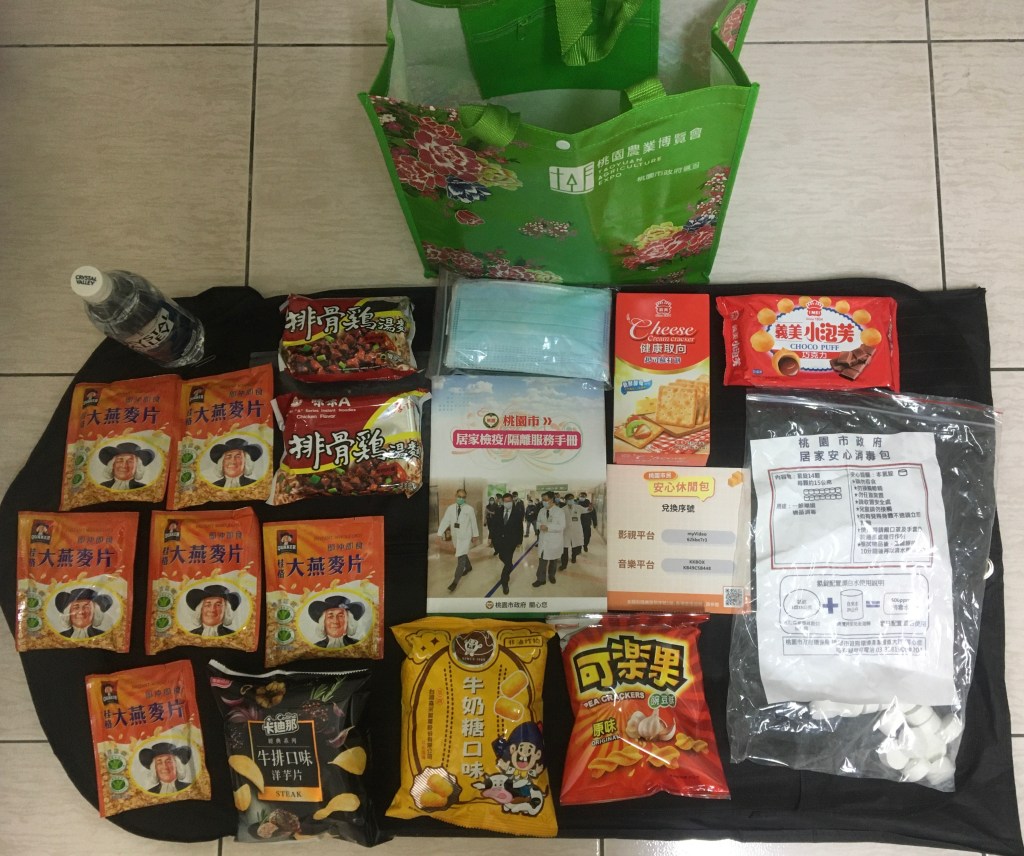
Depending on the local government and supplies available, you may receive a care package too. Mine included: water, oats, noodles, potato chips, crackers, a chocolate snack, an online entertainment pass, bleach tablets, masks and an informational magazine.
Self-Quarantine: my experience
I enjoy my own company most of the time, so I saw this as an opportunity to get things done. My wife was already in Taiwan, pregnant, so she could not stay with me. I do not think she would have been allowed anyway under the rules.
I spoke to my wife every day and family and friends would check in on me from time to time via instant messaging or calls.
I was unemployed, so I used a lot of the time to see what work options were available. I did some online teaching and also got offered a few jobs at physical schools once my quarantine period was over. I occasionally did some HIIT using YouTube videos. I signed up for Netflix for one month and enjoyed watching TV shows for some of the time. Receiving a care package from the local government really made my week. These were the things that got me through.
The hardest part was not being allowed outside. Our apartment was a small studio with minimal natural light and one window to stick my head out of from time to time.
Information on symptoms of Covid-19 were still developing, so I was often nervous about whether I had it or not. It certainly tests your frame of mind.
Routine is so important-when all you have is time, it is very tempting go to bed at random times or stay in bed all the time, but keeping a normal routine helped me stay sane. My biggest test was the boiler breaking early on-no hot showers without boiling water from a kettle.
The first thing I did once my quarantine ended? I ran outside and sat in the local park at midnight, enjoying the fresh air!
The take-away? It was challenging mentally, but I got through with a lot of support from my wife, family, friends and the Taoyuan City Government.
Taiwan’s response to Covid-19
In Taiwan, due to previous experience with epidemics, preemptive measures were taken early on. Borders were closed to everyone except residents and their family members (and later, just residents). Strict quarantine measures were put in place: 14 days self-quarantine and mandatory mask wearing in all public spaces. Many large events were cancelled or restricted. Temperature checks were required in virtually all public places, with infra-red cameras installed in train stations.
All of the restrictions put in place give me confidence in Taiwan’s ability to keep the public safe.
In retrospect, New Zealand did fairly well and ultimately modelled some of its response on Taiwan’s.
Conclusions (lessons learnt)
I do not know what life in Auckland is like now, but I know my industry is still struggling. More of my coworkers and friends lost their jobs. One of my friends was even unable to renew his visa on the basis that many New Zealanders lost their jobs. This is a similar story around the world.
However, there are lessons from this and there is hope.
Until this is over, only travel if you need to, take precautions and follow the rules and guidelines.
If you are unable to go to work, can you earn money online? Or can you start learning a pandemic-proof skill to earn money in the future?
If you find yourself in any form of quarantine or isolation; routine, exercise, productivity, learning new skills, planned activities and communication are all great tools to help your physical and mental health.
Just like the New Zealand and Taiwan governments did and still do-we need to talk about it.
Talk about the facts.
At my school, we gave our students space to talk about their feelings and kept them up to date on the current rules and officially published knowledge about Covid-19. My coworkers and friends were great at balancing positivity, humour and realism which helped massively. All of these things helped minimise the fear.
Governments need to be prepared for another epidemic, with a clear plan and a stockpile of supplies. In the event of another epidemic, they need to act quickly. Preemptive action, communication and education are what has kept Taiwan fairly open and normal. If governments are unwilling or unprepared, we can take steps to protect ourselves regardless-social distancing, masks, essential travel only.
It has been encouraging to see how this has brought many people together. Families spending more and more time together (physically or online), friends checking in on each other. It has been great to see how supportive everyone can be. It has shown many people the value of time, and given people space to prioritise what is important to them.
Now that vaccines have been developed and are being received, and many countries are taking it more seriously, there is hope that in the not too distant future, societies and borders around the world will be open again and people can be reunited. I think we are all looking forward to that!
Until then, stay safe!
Useful links
https://www.immigration.gov.tw/5475/ -go here for up to date immigration rules and information
https://www.boca.gov.tw/mp-2.html -go here for up to date immigration rules and information (including visas)
https://www.cdc.gov.tw/En -go here for up to date information on Covid-19 information and prevention rules in Taiwan
https://www.youtube.com/watch?v=-9MZis8-xO4 -an interview about Taiwan’s epidemic experience with Steve Kuo, former Director-General at Taiwan’s Centers for Disease Control
 thejourneyx